
Unified Commerce in Wholesale B2B: Lessons from Multinational Rollouts

The concept of unified commerce in the B2B wholesale industry is no longer a luxury but a necessity for driving digital transformation and maintaining a competitive edge. Traditional e-commerce platforms, often designed for generic retail, struggle to meet the specific, intricate needs of sectors like steel, metals, manufacturing, and distribution. This gap in the market led to the creation of Slize, a platform purpose-built to solve real wholesale challenges by integrating and streamlining disparate systems into a cohesive, high-performance ecosystem. So let’s review what the market pain points are and the solutions to them.
What are the wholesale B2B challenges?
The wholesale B2B market is characterized by complexities that baffle standard digital solutions. Businesses in these sectors deal with:
Complex product handling
Products often involve intricate logistics, diverse units (such as kilos, meters, and bundles), cutting services, and detailed certifications. Managing leftover materials and ensuring full traceability are also critical, particularly in regulated industries such as steel, medical, and chemical.
Fragmented systems
Many industrial companies operate with multiple ERP systems across different countries or subsidiaries, leading to data silos and inefficient processes. Manual order entry is time-consuming and error-prone, hindering digital sales growth and tying up full-time roles.
Dynamic pricing and volatility
Industries that work with steel face highly volatile raw material prices, often influenced by global markets like the London Metal Exchange. This necessitates sophisticated, real-time pricing mechanisms that traditional ERPs cannot deliver with the required granularity.
These challenges highlight why a generic e-commerce solution is insufficient; a platform should be deeply rooted in the operational realities of industrial sales professionals. Let’s consider below specific examples of how to cope with these challenges.
Slize’s approach to unified commerce
Slize addresses these intricate needs through a modular and composable architecture that acts as an operational backbone for B2B organizations. Its core philosophy revolves around seamlessly connecting existing enterprise systems and consolidating relevant information into a single, accessible, and unified interface.
Composability and deep integration
Slize is designed as a composable system, allowing clients to integrate their preferred tools, such as PIM (Product Information Management) and ERP systems via API, rather than forcing a monolithic solution. This approach offers a future-proof architecture, preventing vendor lock-in and allowing technologies to be swapped as needed. Slize works with clients running multiple ERPs across countries, demonstrating its robust multi-ERP compatibility.
Managing client self-service
The platform offers a comprehensive client self-service portal, designed to replace manual order processes and improve the buyer experience. Key features include:
- Saved baskets and favorite products: Clients can prepare and store shopping carts for future orders or mark frequently purchased items for quick reordering, streamlining ongoing procurement.
- Order and invoice access: Customers have instant access to past and current orders, downloadable confirmations, invoices, and packing slips, simplifying accounting and order management.
- Certificate downloads: Essential in regulated industries, customers can instantly download certificates with chemical and mechanical properties for materials, critical for traceability in long-term projects.
- Advanced search: Users can quickly locate specific purchases using internal project references, order numbers, or material charge (serial) numbers.
Dynamic pricing mastery
Slize’s advanced pricing engine is a standout feature, supporting both dynamic and fixed pricing strategies crucial for volatile markets. It handles billions of live price combinations for clients managing tens of thousands of SKUs and customers.
The system utilizes concepts such as Repurchasing Cost (RPC) – today’s supplier price – and Management-adjusted RPC (MRPC) – used for margin protection or bulk purchases.
- Templates and brackets: Pricing logic relies on segmentation templates (e.g., “Keep Happy,” “Co-Develop”) and quantity-based pricing brackets.
- Granular rule structures: Margin logic can be defined by product type, size, wall thickness, steel/aluminum grade, market volatility, and custom tolerances, allowing for highly differentiated pricing based on product specialty. This level of detail is something that traditional ERPs often struggle to manage.
Advanced sales enablement tools
Slize equips sales teams with tools that significantly boost productivity and reduce manual effort.
- Shadow mode: Sales representatives can impersonate any customer account to guide them through the platform, create orders on their behalf, and troubleshoot issues in real-time. This feature alone has helped clients like Damstahl reduce order entry time by 80%.
- Sales-controlled order creation: Sales reps can convert customer carts into quotations, add delivery modes, force order holds, and even override system margins, providing granular control over the sales process.
- Stock factor management: To mitigate panic buying during price fluctuations, sales can restrict product visibility by customer loyalty or segment, displaying only a portion of the available inventory.
Configurable logistics and automation
Slize offers highly configurable logistics logic, including multi-warehouse support with client-specific fulfillment rules. For example, Damstahl utilized rules to deplete stock from specific warehouses in a predetermined order flow, optimizing costs and enhancing fulfillment speed. Automation handles delivery combinations without requiring client interaction.
Industry-specific intelligence
The platform inherently supports complex units (kilos, meters, bundles), cutting services, and provides visibility into leftover materials, certificates, and full traceability. This is crucial for industries that require strict compliance and detailed product information.
We’ve already mentioned some examples from Damstahl, and now we will share their experience in more detail.
How to Overcome ERP Bottlenecks Without Pausing Your Digital Growth
Migrating or upgrading your ERP system shouldn’t stop your digital transformation.
Key lessons and practical examples
Through ongoing co-development with large industrial companies, Slize has evolved to address the specific complexities of multi-ERP environments, price volatility, and regulatory requirements of multinational operations.
Damstahl (A flagship of scale and efficiency)
As a co-developer, Damstahl, a leading steel distributor, is a foundational user of Slize. They rapidly scaled their digital orders from 98M to 956M DKK (approx. €12M to €128M) in just 18 months, a 10x increase. Slize also helped them save 48 full-time roles through automation and achieve 24% higher profit margins on digital orders compared to phone orders. Damstahl also unified their marketing site and shop into a single cohesive web experience, creating a seamless customer journey. They even used Slize to create a unique CO₂ emissions calculator to calculate the carbon footprint of custom ESG reporting materials, as well as to develop an AI assistant trained to have its own knowledge to solve technical queries.

- Damstahl leveraged Slize to grow digital orders from 98M to 956M DKK, saving 48 full-time roles through automation and achieving 24% higher profit margins on digital sales. Their unified platform also includes a CO₂ emissions calculator and a custom AI assistant for technical queries.

Vargus (Managing multi-ERP environments)
Vargus faced challenges with traditional leadership and multiple failed implementations by cheaper vendors. Slize provided a tailored digital catalog and commerce solution, proving its ability to operate effectively even with clients using five different ERP systems across countries.
A key lesson from this rollout was the importance of data preparation and staged implementation, leading Slize to adapt its onboarding process to include hourly-based pre-deployment discovery and data readiness steps.
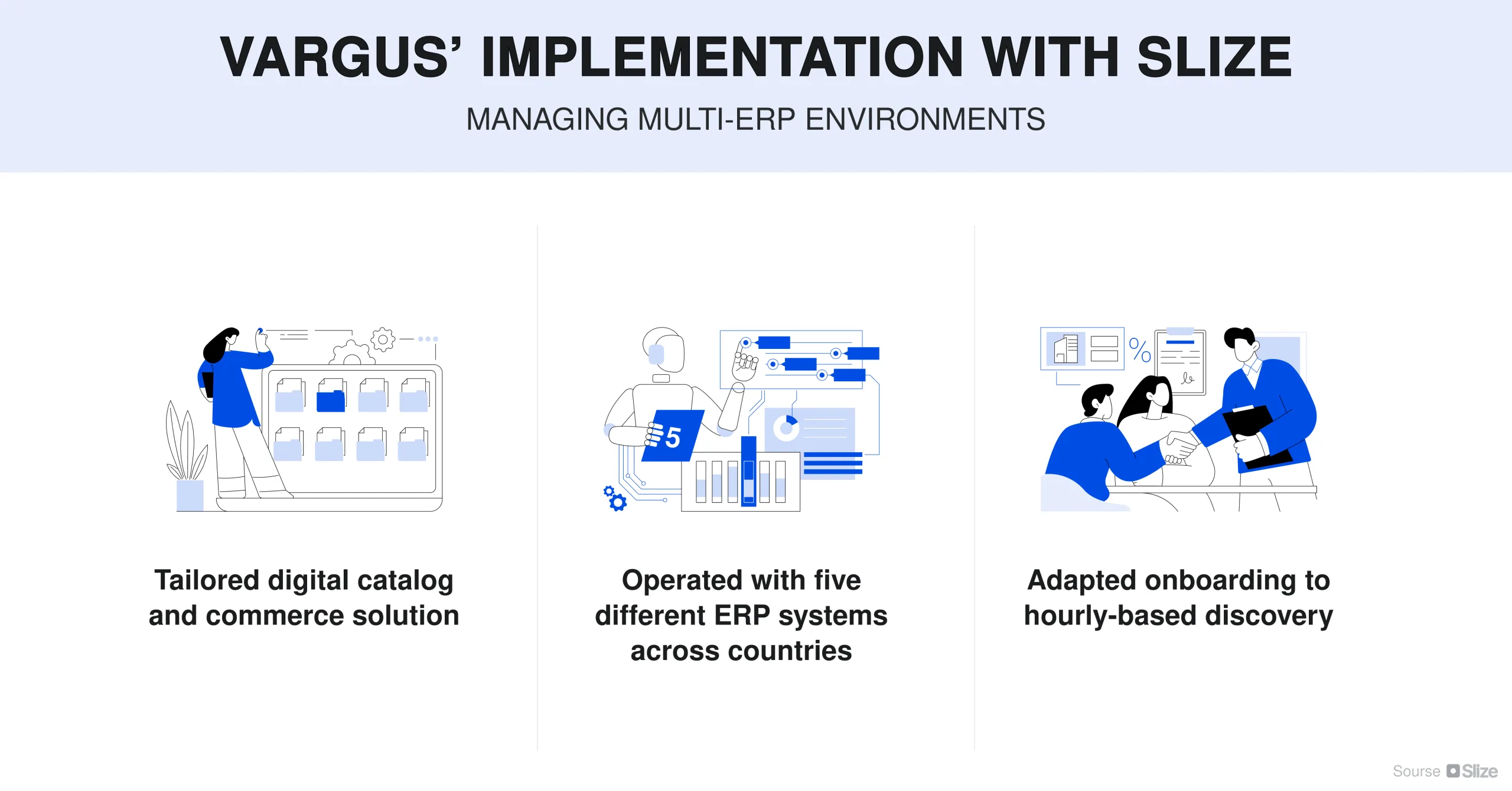
By implementing a tailored digital catalog and commerce solution from Slize, Vargus overcame previous failed rollouts and unified operations across five ERP systems. The project reinforced the value of data preparation and staged implementation.
Weinmann Aach (Flexibility in customization)
Weinmann Aach, a construction steel supplier, exemplifies how Slize’s flexibility in front-end design and pricing logic can be tailored to match industry-specific workflows. Unlike traditional e-commerce platforms that rely on long scrolling product pages, Weinmann Aach chose a modern no-scroll interface with a drawer layout, allowing customers to open product details and service configurations in expandable panels without leaving the main view.
This interface is designed for speed and precision, aligning with how procurement teams in construction work, prioritizing fast, error-free ordering over heavy visual storytelling. With inline configurations, buyers can quickly select dimensions, services, and quantities without navigating multiple pages.
Weinmann Aach also demonstrates the value of Slize’s advanced pricing engine. Since their product costs are relatively stable, they opted for a simple, fixed-price model (€4/kg). Slize’s pricing templates and rule sets allowed them to maintain this flat-rate pricing while still leveraging historical sales graphs and cost trend tracking for future margin protection.
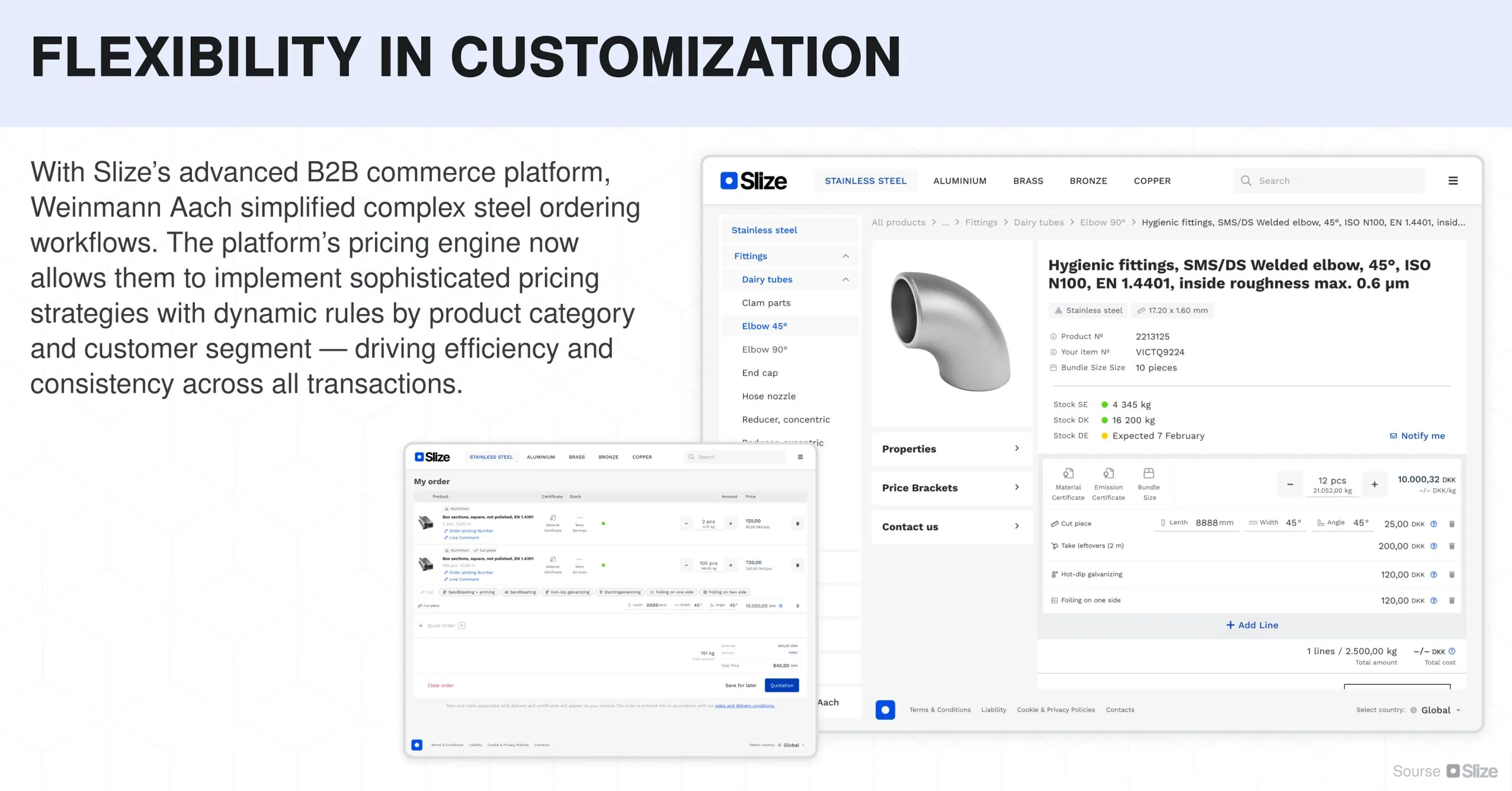
Weinmann Aach adopted Slize’s flexible front-end design with a no-scroll drawer layout to enable precise, rapid ordering. Their fixed-price model (€4/kg) is powered by Slize’s advanced pricing engine, ensuring margin protection and procurement efficiency.
Quantifiable impact and future-proofing
Digital maturity without compromising on complexity or control.
80% faster order entry for sales teams
48 full-time employees saved through automation
10x growth in digital orders in 18 months
24% higher gross profit on digital vs. offline orders
Looking ahead, Slize continues to innovate with upcoming features, including AI Order Automation, which will extract and match order data from customer PDFs and emails, automating basket creation and eventually enabling direct XML order processing from customer ERPs. Sales Dashboards with AI-recommended actions and price trend graphs are also on the roadmap, further enhancing sales team productivity.
The lessons learned from multinational rollouts underscore Slize’s ability to manage complex ERPs, address crucial data trust concerns, and deliver quantifiable ROI.
5 Signs You Need Unified Commerce Before Your ERP Migration
Here’s how to know if you need Unified Commerce before (or alongside) your ERP project.